
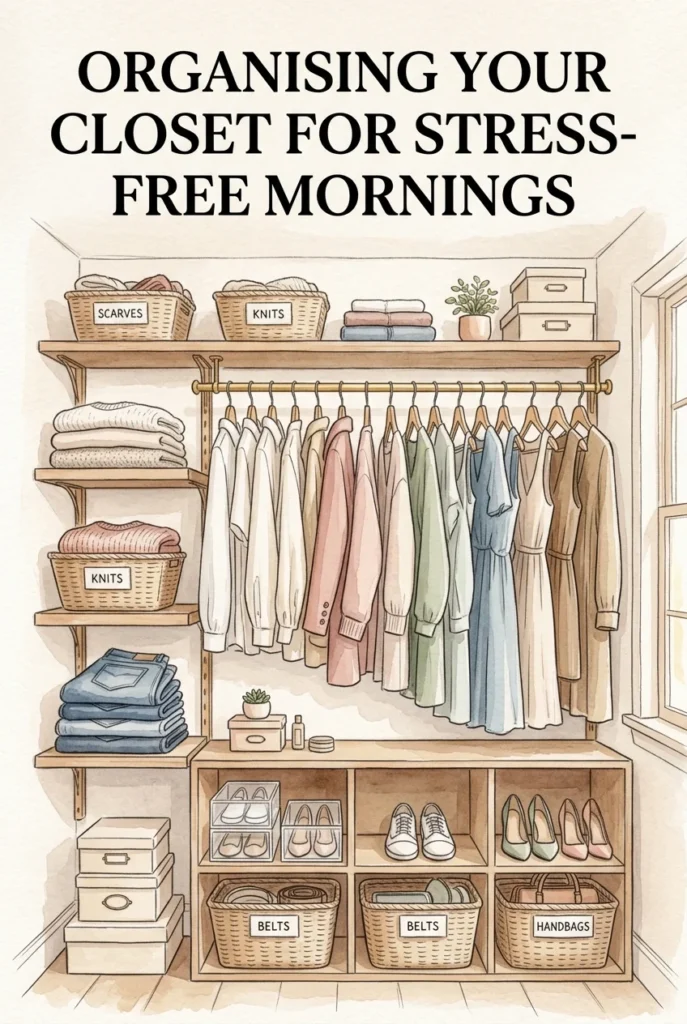
A closet that works for your life can turn rushed mornings into simple, repeatable routines.
A messy closet doesn’t just look untidy—it quietly adds friction to your day. When clothing, shoes, and accessories are hard to see or reach, getting dressed takes longer, choices feel harder, and items end up in piles that are easy to ignore until the problem feels “big.”
An organised closet does the opposite. It creates a system you can maintain, helps you see what you already own, and makes it easier to wear more of your wardrobe. As a bonus, when you can clearly see your options, you’re less likely to buy duplicates of items you already have.
Below is a practical, step-by-step method for organising your closet the right way—one that focuses on function first, then appearance, so it stays both useful and pleasant to open every day.
Why Closet Organisation Matters (Beyond Neatness)
Closet organisation is a daily-life upgrade because it reduces the small, repeated frustrations that add up over time. A good setup supports you in three core ways:
- Less stress in the morning: You spend less time hunting for what you need.
- Less decision fatigue: Clear categories and fewer “maybe” items make choices simpler.
- Better use of what you already own: When you can see your wardrobe, you naturally wear more of it and avoid buying duplicates.
Step-by-Step: How to Organise Your Closet the Right Way
Step 1: Empty Everything Out
Start by removing every item from the closet—clothes, shoes, bags, accessories, and anything else that migrated in over time. Place everything on a bed, a clean floor area, or another large surface where you can see it all at once.
This step matters because it forces a reset. You get a clear view of what you own, what you actually use, and how much space you truly have to work with.
Step 2: Declutter With Purpose
Closet clutter isn’t only a space issue; it creates mental clutter, too. Go item by item and ask:
- Do I wear this often?
- Does it fit my current size and style?
- Do I feel good when I wear it?
If the answer is consistently “no,” it’s a strong candidate to donate, sell, or recycle. Keep what you love, what you need, and what you genuinely use.
If you get stuck, focus on reality over intention. A closet built around your actual life is easier to maintain than one built around “someday” outfits.
Step 3: Categorise Your Clothes
Once you’ve edited your wardrobe, sort what you’re keeping into clear categories. This prevents random piles and makes it easier to assign space logically.
- Tops: blouses, T-shirts, sweaters
- Bottoms: jeans, trousers, skirts
- Dresses and jumpsuits
- Outerwear: jackets, blazers, coats
- Shoes
- Accessories: belts, scarves, handbags, hats
When categories are consistent, putting laundry away becomes faster, and you’re less likely to “lose” items inside the closet.
Step 4: Invest in Matching Hangers
Uniform hangers create an immediate visual calm, but they also improve function. Slim velvet, wooden, or other consistent hangers save space and help keep clothing from slipping off.
Use heavy-duty hangers for coats and blazers so structured pieces keep their shape. Consistency also helps prevent stretching and keeps your hanging section evenly spaced, which makes scanning for outfits easier.
Step 5: Organise by Category, Then by Colour
Hang clothing by category first (all shirts together, all jackets together, and so on). Then, within each category, arrange items by colour from light to dark.
For example: whites → creams → light colours → mid-tones → dark colours.
This approach is simple, visually clean, and practical. When you need a specific piece—like a light top to pair with dark trousers—you can find it quickly without reshuffling half the closet.
Step 6: Use Vertical Space Wisely
Many closets have unused vertical space above hanging rods, below hanging garments, or in corners. Use that space intentionally with:
- Shelves for folded items or bins
- Stackable bins to create “zones”
- Hanging organisers for shoes, sweaters, or accessories
If you use opaque bins, label them so you always know what’s inside. Clear bins can also make it easier to spot what you need at a glance.
Step 7: Fold the Right Way (Not Everything Belongs on a Hanger)
Some items store better folded, either because they stretch on hangers or because folding makes them easier to stack and see. Good candidates for folding include:
- Jeans and casual trousers
- Knit sweaters (to avoid stretching)
- Workout clothes
- Pyjamas and loungewear
Consider file-folding (folding items so they stand upright in drawers or bins). This keeps everything visible, prevents “bottom-of-the-stack” pieces from being forgotten, and helps your folded sections stay neat with less effort.
Step 8: Store Shoes Smartly
Shoes can quickly make a closet look messy, especially when they live on the floor in loose pairs. Get them off the ground and into a system that protects them and keeps pairs together.
Options include:
- Clear shoe boxes for protection and visibility
- Over-the-door organisers for small spaces
- Shelf risers to double the usable space on one shelf
- Seasonal rotation (store off-season shoes in bins)
A simple rule helps: keep everyday shoes within easy reach, and move occasional or off-season shoes to higher shelves or bins.
Step 9: Give Accessories a Real “Home”
Accessories often create clutter because they don’t have an obvious storage spot. The solution is to assign each type of accessory a dedicated home, using simple organisers such as hooks, trays, or drawer dividers.
- Belts: hooks or drawer dividers
- Scarves: ring organisers, hooks, or neatly rolled in drawers
- Jewellery: small trays or divided organisers
- Handbags: store upright with tissue paper inside to help keep their shape
When accessories are easy to see, they’re easier to use—so you get more value from what you already own.
Step 10: Create a Seasonal System
Closets feel crowded when they’re trying to store every season at once. Make things easier by rotating your wardrobe seasonally.
Store heavy coats and winter gear in bins during summer, and tuck away light dresses and warm-weather items during winter. This keeps your everyday options front and centre, which reduces clutter and speeds up daily routines.
Step 11: Maintain It With a Weekly Reset
Organisation only works when it’s maintained. The good news is that maintenance doesn’t need to be a big project.
Once a week, set aside five minutes to:
- Put items back where they belong
- Rehang anything that landed on a chair or hook
- Fold any “strays” that ended up in stacks
- Move worn pieces toward the laundry
Small, consistent resets keep your system intact and prevent the need for frequent full re-dos.
Tips to Make Your Closet Look Organised and Feel Effortless
- Prioritise accessibility: Place your most-worn items at eye level and within easy reach.
- Create simple zones: For example, “work,” “weekend,” and “special occasion” sections can make getting dressed faster.
- Keep like with like: If you always store the same categories in the same places, tidying becomes automatic.
- Use labels when needed: Especially for bins that hold seasonal items, accessories, or shoes.
- Protect structure: Use sturdy hangers for coats and blazers, and fold knits to prevent stretching.
- Leave breathing room: An overpacked rod makes clothing hard to browse and easier to wrinkle.
A Simple Closet Organisation Checklist
| Task | Goal |
|---|---|
| Empty the closet completely | See everything you own and start with a clean slate |
| Declutter with clear questions | Keep only what fits, gets worn, and feels good |
| Sort into categories | Make storage decisions easier and reduce random piles |
| Switch to matching hangers | Create visual order and protect clothing |
| Arrange by category and colour | Find items quickly and keep the closet visually calm |
| Use vertical space | Increase capacity without increasing clutter |
| Fold items that should be folded | Prevent stretching and improve visibility |
| Store shoes off the floor | Prevent damage and keep pairs together |
| Assign a home to accessories | Stop small items from creating big messes |
| Rotate seasonally | Keep only current-season items in prime space |
| Do a weekly five-minute reset | Maintain the system with minimal effort |
Common Closet Problems (and Simple Fixes)
“I organised it, but it gets messy again.”
This usually means the system is slightly harder than it needs to be. Make the “put away” step easier by widening categories (fewer micro-sections) or moving the most-used items into the most accessible spots. Then rely on the weekly reset to keep things from drifting.
“I don’t have enough space.”
Maximise what you have by using vertical storage, slim matching hangers, and seasonal rotation. Often, the goal isn’t to store more—it’s to store smarter so your closet functions without constant rearranging.
“I forget what I own.”
Stick to clear categories, colour order, and visible storage (or labels). The easier it is to scan your closet, the more likely you are to wear what you already have.
The Bottom Line
An organised closet isn