
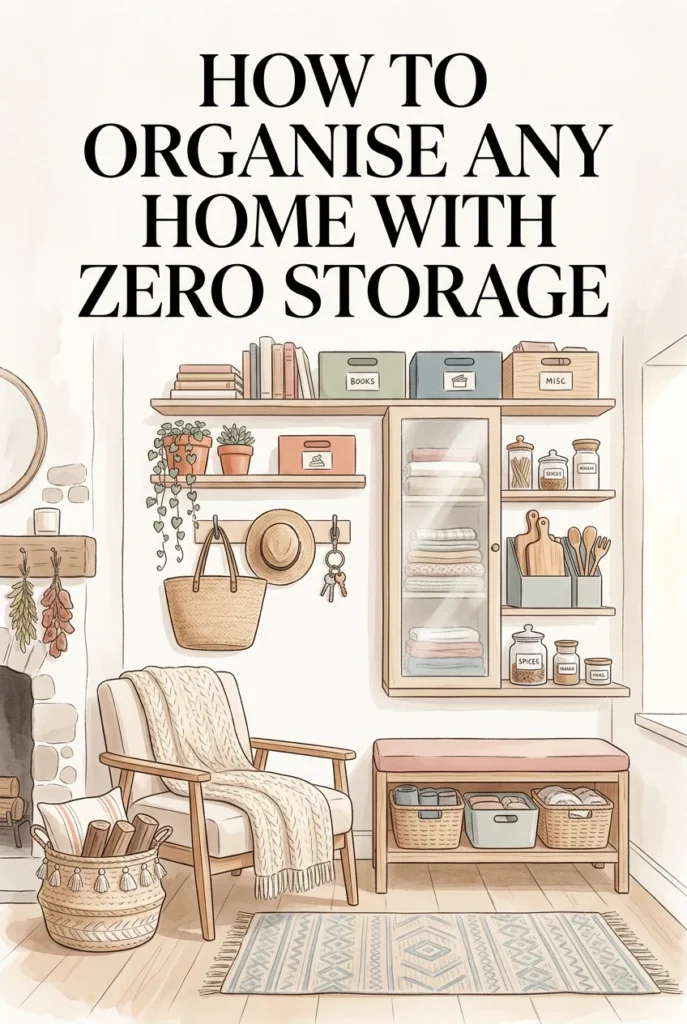
No closets? No entryway? Tiny cabinets? You can still create a calm, functional home.
Living in a home with little (or no) built-in storage is a common, frustrating reality—especially in older properties, small flats, and layouts that simply weren’t designed for modern life. When there’s nowhere obvious to put coats, cleaning supplies, spare bedding, or even a decent stack of towels, clutter doesn’t just “appear”; it accumulates because your home lacks the systems to contain it.
The good news: an organised home is not reserved for large houses with walk-in closets. It’s built through intentional choices, repeatable routines, and storage that’s created (not magically discovered). With a few strategic upgrades, even the most storage-starved space can feel clear, comfortable, and easy to maintain.
Note: This is general lifestyle guidance for home organisation. Use safe materials, choose fixtures appropriate for your walls, and secure anything wall-mounted properly. Adapt each idea to your specific space and household needs.
Why Organisation Matters More When Storage Is Limited
When a home has minimal storage, everyday life gets harder in small, compounding ways: you waste time hunting for items, surfaces become drop-zones, and cleaning feels like moving piles from one place to another. Organising is not about perfection; it’s about creating reliable “homes” for your belongings so your space can support your life.
A well-organised small home can also feel bigger. Clear floors, open surfaces, and predictable storage zones reduce visual noise and make daily routines smoother—especially in high-traffic areas like the kitchen, bedroom, and bathroom.
The Small-Space Organisation Mindset
Before buying baskets or reworking furniture, start with a principle that makes every small space easier to manage:
Every item must earn its space.
This doesn’t require strict minimalism. It simply means being honest about what you use, what you love, and what you’re willing to store. In a storage-poor home, “keeping everything” often creates a constant, low-level mess because there’s nowhere to put overflow.
Decide What “Earning Space” Looks Like
Use a simple filter:
- Useful: you use it regularly or it supports an important routine.
- Beautiful: you genuinely enjoy seeing it out (and it contributes to the room).
- Meaningful: it matters to you personally and you’re willing to store it properly.
If an item doesn’t fit at least one of these categories, it may be time to rehome it, replace it with a more compact option, or limit it to a defined container (so it cannot expand endlessly).
Think in Zones, Not Rooms
In homes with limited storage, one piece of furniture often serves multiple purposes, and “zones” become more useful than “rooms.” A single wall might hold your entry drop-zone, a cleaning supply cabinet, and your family calendar area. When you organise by zones, you can build systems that match how you actually live.
Room-by-Room Storage-Savvy Solutions
1) Entryway (Even If You Don’t Have One)
When there’s no formal entry, clutter tends to land at the door: shoes, coats, bags, post, keys. The goal is to create a defined landing zone so items stop spreading.
What to do
- Install wall hooks or a mounted coat rack to get outerwear and bags off the floor.
- Add a small bench with storage underneath so shoes have a consistent home.
- Use a mirror with a small shelf for keys, sunglasses, and mail (and to visually open the space).
- Place a sturdy basket for shoes when a shoe rack won’t fit, or when you want a softer look.
If you’re short on wall space, focus on one vertical strip near the door and keep the “entry kit” limited to the essentials you use daily.
2) Living Room
The living room often becomes the “everything room”: devices, cords, books, games, throws, paperwork. Without storage, you’ll see constant surface clutter. Aim for furniture that hides function inside it.
What to do
- Choose storage furniture (ottomans, side tables, or sofas with hidden compartments) to contain daily items.
- Use decorative baskets or lidded boxes for remotes, chargers, cords, and magazines so they’re accessible but not scattered.
- Mount floating shelves to move books or décor upward without taking floor space.
- Repurpose a vintage trunk as a coffee table and store board games, candles, or seasonal items inside.
One helpful rule: keep the coffee table and main surfaces “resettable” in under two minutes. If it takes longer, you likely need a larger catchall or one additional storage point within arm’s reach.
3) Kitchen
Kitchens with minimal cabinetry are challenging because they hold high-volume, high-use items. The win comes from doubling cabinet capacity and moving select items to walls.
What to do
- Hang utensils and pots on a peg rail or wall rack to free drawers and cupboards.
- Add risers inside cabinets to create a second “shelf” and prevent stacking chaos.
- Use magnetic spice tins on the fridge or on mounted metal boards to reclaim drawer space.
- Store cutting boards vertically in file sorters so they’re easy to grab and don’t topple.
As you set up your kitchen, prioritise what you use weekly at the easiest height to reach. Items used less often can live higher up, lower down, or in a secondary zone (such as a lidded box on a shelf).
4) Bedroom
Bedrooms without enough closet space can quickly feel cramped, especially when out-of-season clothing has nowhere to go. Your aim is to use hidden volume (under the bed) and make the closet you do have work harder.
What to do
- Use under-bed storage bins, ideally rolling drawers or lidded boxes to reduce dust and visual mess.
- Store seasonal clothing in suitcases so the luggage does double duty and doesn’t sit empty.
- Add hooks inside closet doors for belts, scarves, handbags, or frequently worn items.
- Create a “containment tray” on the dresser to corral jewellery and perfume instead of letting small items spread.
If your wardrobe is bursting, choose one boundary (a drawer, a shelf, a set of hangers) and commit to that limit. In small homes, boundaries keep systems stable.
5) Bathroom
Bathrooms often have the least storage and the most daily-use items. Small improvements make a big difference, especially when you move items off the sink.
What to do
- Install shelves above the toilet to capture unused vertical space.
- Use a narrow rolling cart beside the sink or tub for toiletries, cleaning items, and backup supplies.
- Hang a towel bar behind the door for towels or robes without sacrificing wall space.
- Store cotton pads and cotton swabs in pretty jars so everyday items can look intentional and decorative.
A quick check that keeps bathrooms calm: keep only the products you truly use in reach, and store backups in one defined bin so they don’t scatter across multiple shelves.
6) Closet-Free Zones (When You’re Working With Almost Nothing)
Some homes truly lack closets, or have closets too small to function. In that case, the goal is to create “pseudo-closets” that look tidy and feel intentional.
What to do
- Use garment racks with fabric covers to create a closet effect while keeping visual noise down.
- Add curtains to open shelves for instant calm—especially in bedrooms and multipurpose rooms.
- Store linens under the bed or in baskets on a high shelf to keep bulky items contained.
When you’re relying on open storage, consistency matters: matching hangers, a limited colour palette of bins/baskets, and clear category boundaries make the space feel organised rather than exposed.
Tips: Quick Wins That Make Any Small Space Feel Organised
- Go vertical first: walls, the backs of doors, and high shelves are your “extra closets.”
- Contain before you label: choose a basket, bin, tray, or box for the category, then label if needed.
- Limit duplicates: in low-storage homes, extras can quietly become clutter (especially in kitchens and bathrooms).
- Choose storage you don’t mind seeing: attractive containers reduce visual clutter even when items must stay out.
- Keep frequently used items closest: the easier something is to put away, the more likely it will stay organised.
- Use “one-touch” drop zones: keys, post, and bags should have a home you can reach immediately when you walk in.
Creative Catchalls That Also Work as Decor
When your home lacks built-in storage, your storage solutions are often visible. The advantage is that you can choose items that complement your style while doing real organisational work.
Ideas to borrow
- Vintage crates for blankets, books, or toys (easy to slide under a console or beside a sofa).
- Tiered trays for bathroom counters to keep everyday items grouped and upright.
- Wall baskets for mail, papers, or grab-and-go essentials.
- Apothecary jars for laundry pods or pantry snacks when you want function that looks tidy.
- Glass canisters for bulk dry goods—efficient, visible, and often more attractive than packaging.
In small spaces, “pretty and practical” is not a luxury; it’s a strategy. If you like how your storage looks, you’re more likely to maintain it.
Keep It Cosy, Not Cluttered
Organising without built-in storage is largely about managing how much is visible. Even well