
A practical, no-drama guide to the skills and mindsets that make midlife less reactive—and more self-directed.
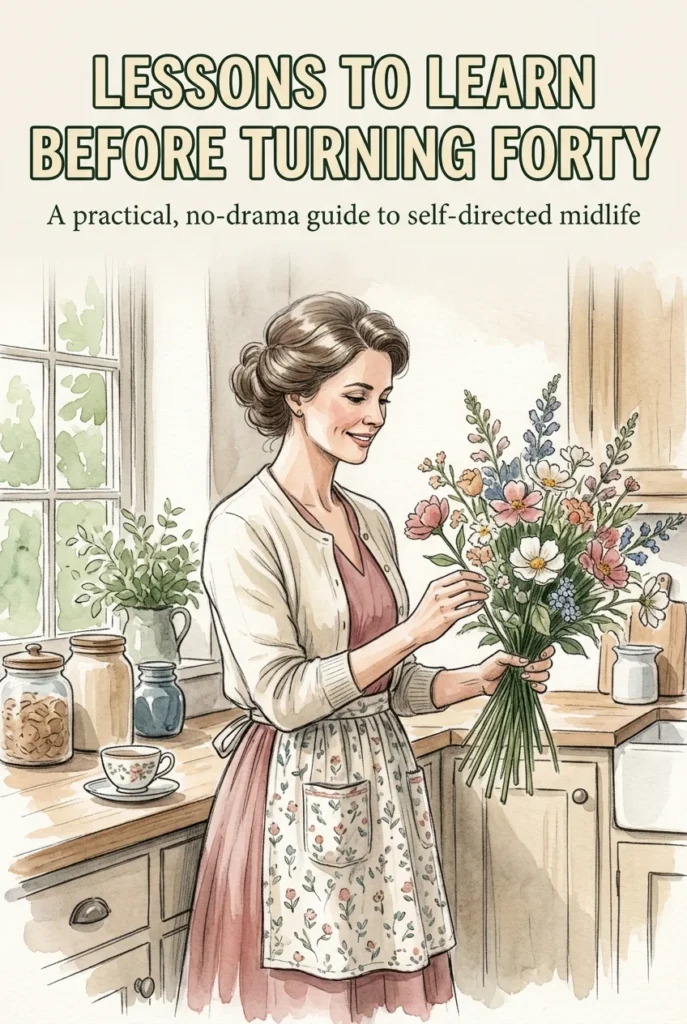
Imagine standing in a flower shop on an ordinary day and choosing a bouquet for yourself.
No permission. No occasion. No one else’s idea of what you “should” want.
That small decision carries a bigger message: your life is allowed to include beauty, agency, and care—right now.
Turning 40 isn’t an ending. It’s a threshold. Many people experience it as the moment when who they’ve been starts to align more closely with who they intend to be. If your twenties were about exploring and your thirties were about building, your forties often become the decade of refinement—less noise, more clarity.
Why These Lessons Matter Before 40
These ten lessons aren’t abstract “life advice.” They’re practical skills. They influence how you spend your time, how you handle stress, how you make decisions, and which relationships you keep close. They also compound: the earlier you practice them, the easier they are to maintain when life gets busy, demanding, or unpredictable.
Below are ten things worth learning deeply—through repetition, not just reading—so you enter your next decade with steadier footing.
1) Learn That Boundaries Are Not Cruel
Boundaries aren’t a character flaw. They’re a form of clarity. You don’t owe everyone access to your schedule, your emotional energy, or your attention.
What boundaries actually do
Think of boundaries less as walls and more as filters. They let in what supports you and keep out what consistently drains you. They also reduce resentment—because you’re no longer agreeing to things you don’t have the capacity to carry.
How to practice before 40
- Say no without a courtroom-level explanation. A simple “I can’t make it” is enough.
- Leave without drama. You can exit a conversation, a commitment, or a dynamic without making it a scene.
- Protect your peace without apologizing for having needs. Time and emotional capacity are limited resources.
2) Learn How Money Really Works
Financial awareness is freedom. You don’t need to chase status or become “obsessed” with wealth, but you do need to understand the basics—because money affects your options.
What to understand (at minimum)
- Budgeting: knowing what comes in, what goes out, and what you can adjust.
- Debt: how it functions and how it limits future choices if it stays unmanaged.
- Investing and assets: the difference between only earning income and also building long-term stability.
Why it matters
Money is not just about “more.” It’s about choice: where you live, how you work, what you support, and what you can decline. Practical financial literacy is protective and empowering, and it doesn’t need a particular personality type to be effective.
3) Learn to Take Care of Your Body Early
Your body is not a decoration. It’s your home—the place you live every day. The earlier you learn what supports your health, the more your future self benefits.
Make it sustainable, not extreme
You don’t need punishing routines. You need consistency: food that energizes you, movement that you can repeat, and sleep that you treat as non-negotiable care.
Focus on the basics that compound
- Strength and flexibility (so you feel capable and resilient)
- Hydration and nourishment (so energy is steadier)
- Sleep (as a nightly reset you protect like it matters—because it does)
4) Learn That Emotional Intelligence Is a Superpower
Being smart helps. Being emotionally intelligent changes everything—especially in close relationships, work, and conflict.
Core skills to strengthen
- Identify your triggers instead of being surprised by them.
- Pause before reacting so your response reflects your values, not your impulse.
- Communicate needs clearly in a calm, direct way.
- Listen without building a defense while the other person is still speaking.
Emotional maturity reduces chaos. It helps relationships deepen rather than fracture, and it keeps you from repeatedly creating the same problem in a new setting.
5) Learn to Stop Performing for Approval
At some point, it becomes exhausting to live as if you’re constantly auditioning. Approval-seeking can look like perfectionism, over-explaining, people-pleasing, or choosing what’s impressive rather than what’s true.
A reality to accept
Not everyone will understand your choices. Not everyone will celebrate your growth. Some people prefer older versions of you simply because those versions were easier for them to predict—or to influence.
What to choose instead
Choose authenticity over applause. Living in alignment with your values tends to feel quieter than external validation, but it also tends to feel far more stable.
6) Learn the Value of Solitude
Solitude is not the same as isolation. It’s the ability to be alone without feeling abandoned, and it’s where clarity often begins.
Why solitude matters
When you can sit with yourself, you can hear yourself. Without constant input—opinions, expectations, noise—you can identify what you actually want, what you’re tolerating, and what needs to change.
Simple rituals that build comfort with your own company
- Morning journaling for a few minutes before the day starts deciding things for you
- Intentional walks—through your neighborhood or a city—without multitasking
- Reading alone in a café or at home, purely for enjoyment
If you can’t enjoy your own company, it’s easy to rely on other people to fill every quiet space. Learning solitude helps you feel more complete and less reactive.
7) Learn to Invest in Relationships That Grow With You
Not every relationship is meant to be permanent, and not every long-standing connection is automatically healthy.
Questions worth asking
- Is it reciprocal? Do effort and care flow both ways?
- Is it respectful? Are boundaries honored, even when it’s inconvenient?
- Does it support your growth? Do you feel encouraged to expand—or subtly punished for changing?
Growth sometimes requires letting go. It also requires choosing people who are emotionally healthy, accountable, and aligned with your values. Your inner circle should feel like sunlight, not fog.
8) Learn That Time Is Your Most Precious Resource
You can earn more money. You can’t earn more time. The real question is how intentionally you’re spending your days.
Move from reacting to designing
Look at your rhythms: what your mornings look like, how your evenings end, and what consistently steals your attention. Small habits shape entire decades, often quietly.
Time investments that tend to pay you back
- Books you actually finish (and apply)
- Skills you practice consistently, even in small increments
- Routines that reduce friction so your life is easier to run
Design your time the way you would design a beautiful home: with function, flow, and care.
9) Learn to Define Success for Yourself
Society offers a template for success. You’re allowed to decline it.
Define your version in plain language
Is success flexibility? Financial independence? Creative fulfillment? Peace? Travel? Community? Impact? A slower schedule? A stable home base? You don’t need the “right” answer—you need an honest one.
If you don’t define success for yourself, you can end up chasing someone else’s version and wondering why it feels hollow. Clarity also prevents comparison from stealing your satisfaction.
10) Learn to Romanticize Your Own Life (Without Waiting for a Milestone)
You don’t need a special occasion to buy flowers. You don’t need a major achievement to treat yourself with care.
What this looks like in everyday life
Infuse the ordinary with intention. Dress well for regular days. Cook nourishing meals that feel like care rather than obligation. Light a candle while you clean up. Put on music while you make dinner. Walk a little more slowly when you can.
Life is not a waiting room for something bigger. It is happening now. When you practice noticing and choosing small moments of beauty, you train yourself to live with attention—rather than always rushing toward the next thing.
Tips: How to Put These Lessons Into Practice Before Your Next Birthday
- Pick one lesson per month. Focus on it long enough to change behavior, not just intentions.
- Write a “default no.” Decide in advance what you’re no longer available for (guilt-driven commitments, last-minute obligations, emotional labor without reciprocity).
- Set a simple money routine. A recurring weekly check-in is often more effective than rare bursts of effort.
- Choose movement you can repeat. Consistency beats intensity. Build a relationship with your body that you can sustain.
- Audit your inputs. Notice what you consume—conversations, media, schedules—and remove what repeatedly leaves you dysregulated or drained.
- Schedule solitude like an appointment. Protect it the way you protect other responsibilities.
- Define “success” in one sentence. Put it somewhere visible and revisit it when decisions get noisy.
- Create one small daily ritual. Flowers, music, tea, a morning page—anything that reminds you your life is worth tending.
A Closing Thought on Turning 40
People who move into midlife with more ease aren’t the ones who avoided mistakes. They