
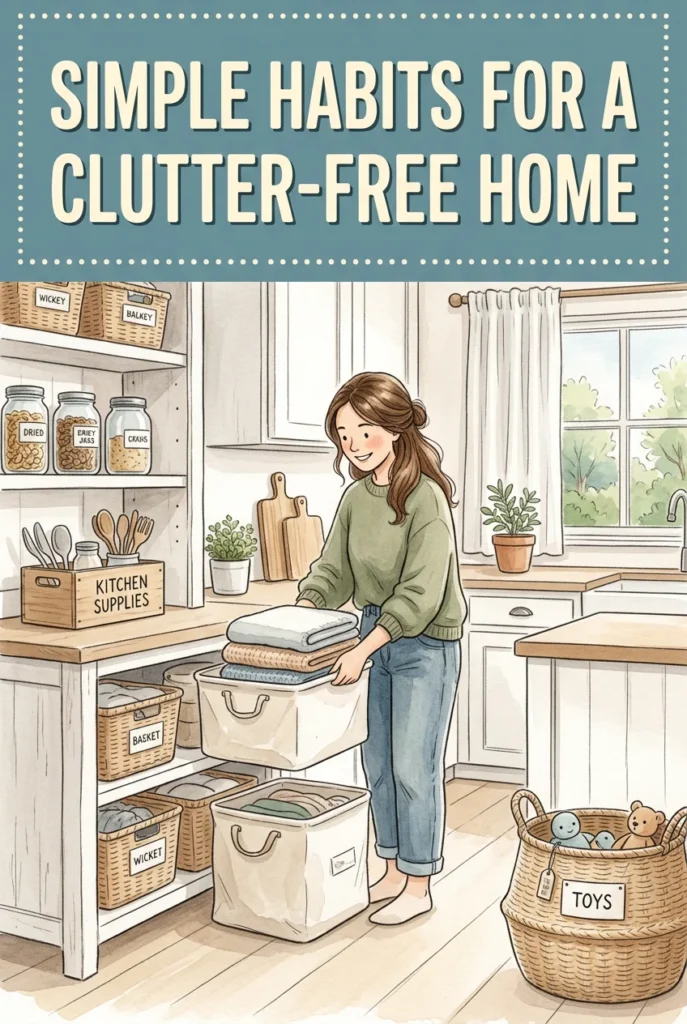
A practical, repeatable approach to keeping your home clear, organized, and easier to live in—one habit at a time.
We’ve all seen those magazine-worthy rooms: clear surfaces, calm closets, and nothing piled “just for now.” It can feel like a different world—especially when your own home is busy, lived-in, and full of daily stuff.
The good news is that a clutter-free home is not reserved for photo shoots or perfect routines. With patience and a real commitment to simple systems, your home can become consistently more organized—and stay that way.
Below are ten practical ways to get your home clutter-free and maintain it over time. None of these require expensive products or a massive weekend overhaul. They work because they reduce the number of decisions you have to make each day and give every common item a predictable “home.”
Why Maintaining a Clutter-Free Home Matters
Clutter isn’t only about how a space looks. It affects how a home functions. When items don’t have a place, they migrate to countertops, chairs, stairs, and floors—and then every task takes longer. You spend more time searching, moving piles around, and cleaning around objects instead of cleaning surfaces.
A clutter-free home makes daily life easier. You can find what you need quickly, reset rooms faster, and avoid the feeling that you’re always behind. The goal isn’t perfection; it’s creating a home that supports your routines instead of competing with them.
10 Ways to Keep Your Home Clutter-Free (and Keep It That Way)
1) Live Within Your Means
Living within your means does more than protect your budget—it simplifies your life. When you buy fewer unnecessary items, you bring less into the house that needs storage, cleaning, and maintenance. Less coming in usually means less clutter over time.
Think “less stuff,” not “more space”
If a closet is overflowing, it’s tempting to wish for a bigger closet or another storage unit. But more space can simply become more room to store things you don’t truly need. A more effective option is to reduce what’s already there by letting go of items you no longer use.
2) Give Everything a Clear Home
A clutter-free home depends on a simple rule: everything should have a place. When items don’t have a designated spot, they end up on tables, counters, and any open surface.
Use containers to keep categories together
Plastic containers are an easy way to group items and keep them contained. When similar items live together, they’re easier to find and faster to put away. Containers also reduce “spreading,” where one small item becomes a messy cluster.
Label for speed
Mark containers so you can quickly see what belongs inside. Labels reduce decision fatigue and help other family members return items to the right place without asking.
3) Put Things Away Where You Can Find Them Quickly
There’s a small but powerful trick to putting things away: store items where you will naturally look for them. The best location is usually the place you use the item most—not the place that looks the neatest on paper.
If you regularly have to search across the house for something at the exact moment you need it, clutter and frustration build quickly. A home that supports quick retrieval is easier to keep organized because “putting away” stops feeling like a separate project.
4) Reduce Paper Clutter (Go Paper-Free When You Can)
Paper has a way of multiplying: mail, school forms, receipts, documents you intend to file, and pages you think you might need later. If you have the right resources, scanning many of these documents can reduce paper clutter dramatically.
Create a simple paper workflow
When you scan documents, you eliminate stacks and piles waiting for attention. The goal is not to keep every piece of paper, but to keep what matters in a format that doesn’t take over your living space.
5) Build the “Put Away” Habit
Clutter often comes from items that were used and then left out “for now.” The fastest way to maintain a clutter-free home is to return items to their place as soon as you’re finished.
Hang the dress you didn’t wear back in the closet. Put the kitchen knife back in the drawer after you use it. Return toiletries, chargers, books, and shoes to their spots. When you do this consistently, it becomes a habit—and habits keep homes organized more effectively than occasional deep cleans.
6) Use a Junk Drawer (On Purpose)
A junk drawer can be a practical tool when it’s used intentionally. Most homes have a handful of random items that don’t fit neatly into other categories. Instead of letting those items float around the house, a single drawer can contain them.
A peacekeeping strategy for shared spaces
If family members frequently leave small items in the wrong places, the junk drawer can help you avoid constant arguments. Rather than letting things spread across counters and tables, you can quickly place them in the drawer and deal with them later. The key is to keep it limited to one designated space so “miscellaneous” doesn’t take over.
7) Prevent Kitchen Counter Clutter
Kitchens collect clutter fast because they’re used throughout the day. A reliable habit is to wash dirty dishes and clear the counters as soon as you’re done cooking.
Clean as you go when possible
If you can manage it, clean while you cook: rinse tools, load dishes, and wipe small spills as they happen. This reduces the post-meal mess and keeps the kitchen from becoming the default landing zone for everything.
8) Reset Your Closet With the Change of Seasons
Seasonal transitions are a built-in opportunity to clear clutter. After each season, wash and properly store the clothing you wore for that time of year. Putting off-season items away creates space, makes your closet easier to use daily, and reduces the “I can’t find anything” feeling.
Make seasonal storage predictable
The purpose isn’t to create a complicated system; it’s to make sure your current-season clothes are the easiest to access. When the closet is aligned with what you actually wear right now, it naturally stays neater.
9) Contain Toy Clutter With One Simple Tool
Toys can contribute significantly to household clutter, especially in shared family spaces. A straightforward solution is to introduce a large basket where kids can toss toys when they’re done playing.
Make cleanup easy enough to do daily
If cleanup requires sorting, lids, or multiple steps, it often won’t happen consistently. A single, large basket reduces friction. Over time, kids can be trained to use it as part of finishing playtime, which keeps floors clearer and makes the home feel more manageable.
10) Create a Laundry Collecting System
Laundry becomes clutter when there’s no clear place for dirty clothes to go. A simple laundry collection system can keep it contained and reduce piles in bedrooms and bathrooms.
Use two main baskets near the machine
Place two tall laundry baskets near the washing machine: one for colored clothes and one for white clothes. This keeps sorting simple and makes it easier to start a load without a big pre-laundry mess.
Add smaller baskets in rooms
Smaller baskets can be placed in each room to keep dirty laundry from landing on chairs or the floor. To keep the system moving, you can implement a rule that on a certain day, occupants bring their baskets to the laundry room and sort into the larger baskets near the machine.
Tips to Make a Clutter-Free Home Easier to Maintain
- Reduce decisions: the clearer the “home” for an item, the faster it gets put away.
- Keep surfaces mostly clear: counters and tables attract piles; treat them as workspaces, not storage.
- Store items where you use them: convenience is what makes systems stick long-term.
- Use labels when it helps: labels make it easier for everyone to reset a space quickly.
- Contain categories: containers and baskets prevent small items from spreading into visual clutter.
- Do quick resets: a few minutes of putting things back often prevents a much bigger cleanup later.
- Let one drawer be “miscellaneous”: a controlled junk drawer is better than uncontrolled junk everywhere.
A Simple Home Reset Routine You Can Repeat
Maintaining a clutter-free home is usually easier than it sounds, especially when you focus on small, repeatable actions instead of occasional marathons. If you want a simple rhythm to support the ten practices above, use a light reset that fits your household.
- Daily (5–10 minutes): return items to their places, clear kitchen counters, and contain laundry.
- Weekly: empty obvious “hot spots” (entryway, coffee table, kitchen island) and do a quick check of the junk drawer.
- Seasonally: wash and store off-season clothing and refresh the spaces that tend to overflow.
Final Thought: Choose Fewer Things, Use What You Need
A clutter-free home isn’t maintained by constant effort; it’s maintained by thoughtful limits and consistent habits. Always remember that you can choose to have fewer things and use only what you need. When you do, you won’t have to stay fixated on organizing and storing unnecessary items. You’ll spend less time managing your home—and more time enjoying it.