
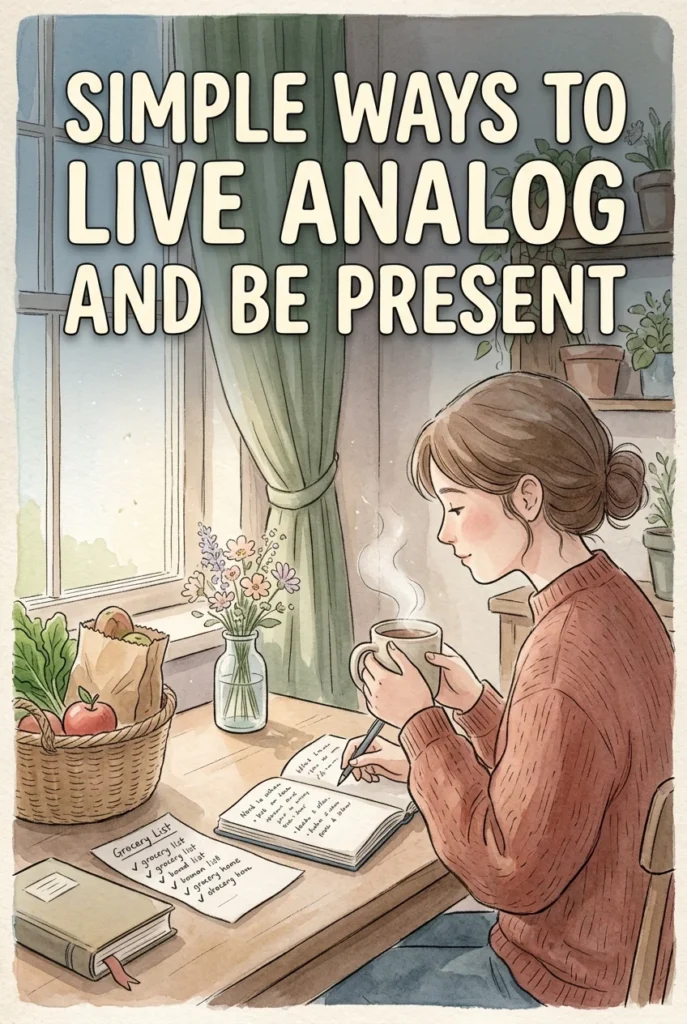
A grounded, realistic guide to reclaiming attention, presence, and daily satisfaction—without rejecting technology.
Notifications move faster than thoughts. Screens fill the quiet spaces of our day before we notice they were ever quiet at all.
Choosing to live a little more “analog” is a small, steady act of control in a world designed for constant pull. It can be as simple as drinking morning coffee without a phone nearby—or as meaningful as redefining what you consider a productive, well-lived day.
Why living more analog matters (especially now)
Many of us spend our mornings waking up to glowing screens, our afternoons switching between tabs, and our evenings scrolling through carefully curated moments—while our own lives sit half-lived in the background. Over time, this can dull the senses and fragment attention.
Analog living is not a rejection of modern tools. It is a choice to prioritize tangible, intentional moments over constant distraction. It brings you back to texture and presence: the feel of paper under a pen, the weight of groceries in your hands, the sound of a paper bag crinkling at a sunlit market.
Think of it as building a life that feels real in your hands, not just impressive on a screen.
10 ways to begin living an analog life (in a digital world)
1) Create daily screen-free rituals
Start with small windows of time that belong fully to the physical world. The goal is not perfection; it is consistency. A few minutes each day can become an anchor.
Try one simple ritual
Choose one moment you repeat daily:
- Morning coffee or tea with your phone in another room
- A short walk with no headphones
- Evening journaling by lamplight instead of scrolling in bed
When screen-free rituals become dependable, your nervous system has room to settle. You start to notice details again: warmth from a mug, a breeze on your face, the way light shifts across the floor. These are small experiences, but they add up to a steadier day.
2) Shop with intention, not urgency
Online ordering is efficient, but it can also remove you from your environment. When you can, try shopping in person with a handwritten list. Move slowly. Let the errand be an experience.
Make shopping a grounding practice
As you move through a market or grocery store, deliberately engage your senses:
- Choose vibrant fruits and leafy greens
- Notice colors, scents, and textures
- Read labels and make decisions without rushing
- Add something simple that brings warmth to your home, like fresh flowers
This isn’t about doing more. It’s about being where you are. Shopping becomes less about speed and more about engagement.
3) Use paper instead of apps (at least sometimes)
Digital planners are convenient, but paper has a different kind of power. A physical planner, a notebook for ideas, or a printed calendar on the wall makes time tangible.
Why paper works
Writing by hand naturally slows thinking and can clarify priorities. You can see your days at a glance, flip through pages filled with your own handwriting, and track progress in a way that doesn’t disappear with a swipe. Crossing out a task, jotting a note in the margin, or sketching a simple plan can make your life feel visible and real.
4) Cook from scratch
Preparing meals from simple ingredients is one of the most analog things you can do. Wash vegetables. Chop herbs. Stir grains in a pot. Let the kitchen sound like a kitchen.
Make it simple and repeatable
This doesn’t need to be complicated to be meaningful. Even a straightforward meal—roasted vegetables, grains, and fresh greens—can feel ceremonial when you do it without distraction. Cooking from scratch connects you to your senses, creates warmth in your home, and reinforces the idea that nourishment takes time and care.
5) Set clear technology boundaries
You don’t need to eliminate technology, but you do need to define it. Boundaries reduce the constant “just checking” habit that can swallow time without delivering satisfaction.
Choose boundaries you can actually keep
Pick a few rules that fit your life:
- Make the bedroom a screen-free sanctuary
- Keep the dining table for food and conversation only
- Charge devices outside the room where you rest
These boundaries are not about restriction for its own sake. They protect your attention and send a message to yourself that your presence matters. Over time, small rules create a lifestyle where you control your tools, instead of the other way around.
6) Reconnect with handwritten communication
Instant messaging is useful, but handwritten notes bring a different kind of connection—one that moves at a human pace. In a digital world, a letter or postcard can feel almost luxurious because it is tangible and deliberate.
Bring back slower connection
Try any of these:
- Write a short letter to a friend
- Send a postcard “just because”
- Leave a small note at home for a loved one (or for yourself)
The act of writing, sealing, and sending something physical adds anticipation and meaning. It’s also a gentle reminder that connection doesn’t have to be immediate to be powerful.
7) Choose experiences over documentation
One of the most transformative analog shifts is deciding not to document everything. You don’t have to turn every moment into content. You can let it be yours.
Practice leaving the phone in your bag
At a market, park, or café, try keeping your phone out of sight. Resist the urge to photograph every detail. Instead, observe: faces, sounds, small movements, the way the day feels. Experiences often feel richer when they are not filtered through the lens of potential online approval. In this approach, presence becomes the priority, not performance.
8) Surround yourself with physical beauty
Analog living is easier when your environment rewards your senses. Physical objects—especially simple, functional ones—invite you to linger in real life rather than defaulting to a screen.
Small changes that make a space feel lived-in
- Fresh flowers in a simple vase
- Linen napkins on the table
- A stack of books on the nightstand
- A woven basket for produce
These details may seem minor, but they create texture and warmth. When your surroundings feel tangible and calm, it becomes more natural to put the phone down and simply be.
9) Embrace slow errands and everyday moments
Living analog is not only about big lifestyle changes. It is, very often, about how you move through ordinary tasks: pushing a trolley through a store, rearranging a pantry, washing produce at the sink, watering herbs on the windowsill.
Turn “chores” into grounding rituals
Approach these moments with calm attention. Focus on one step at a time. Notice what your hands are doing. When you stop rushing through the basics of life, they become less like obstacles and more like small, steady practices that support you. Your day starts to feel like a collection of moments to inhabit, not a list to escape.
10) Redefine productivity
Digital culture often equates productivity with speed, visibility, and constant output. Analog living invites a more sustainable definition: productivity as care, steadiness, and alignment.
Examples of “quiet productivity”
- Reading a chapter of a book
- Preparing meals for the week
- Tidying your space
- Taking care of your body and mind
True productivity is not always loud. It can be the work that stabilizes your life—work that rarely shows up online but deeply affects how your days feel. When you step away from noise, you can hear your own pace again.
Tips to make analog habits stick (without trying to change everything)
The easiest way to build an analog life is to start small and repeat what works. Choose one ritual, one boundary, or one screen-free moment, then let it become normal before adding more.
- Start with one “no-screen” anchor: morning drink, lunch, or the last 15 minutes before sleep.
- Make it visible: leave a notebook and pen where you usually reach for your phone.
- Reduce friction: keep a reusable shopping list pad on the counter; store stamps with stationery; place books where you relax.
- Create device “homes”: decide where devices rest when not in use (and keep them there).
- Pick presence over perfection: if you scroll, return to your next ritual without turning it into a failure.
A simple reminder: this is not nostalgia
Choosing an analog life in a digital world is not about pretending technology doesn’t exist. It is about reclaiming your attention and building days that feel textured, grounded, and fully lived.
You do not have to change everything at once. Begin with one consistent ritual. Add one boundary that protects a meaningful part of your day. Choose one moment to experience without documenting it. Over time, these small decisions weave together into a steadier inner life.
The world may remain fast and digital. Your life, however, can still move at a human pace—and the most meaningful parts of it may never appear on a screen at all.
Suggested printables to support an analog routine
If you enjoy paper tools, these printable-style resources can reinforce your screen-light systems at home:
- Kids Daily Chore Chart – Free Printable Download
- Kids Weekly Chore Chart – Free Printable Download
- Adult Daily Chore Chart – Free Printable Download
- Family Daily Chore Chart – Free Printable Download
- Adult Weekly Chore Chart – Free Printable Download
- Family Weekly Chore Chart – Free Printable Download
- Grocery List – Free Printable Download
- Monthly Amazon Shopping List – Free Printable Download
- Weekly Meal Planner – Free Printable Download
- Monthly Errands List – Free Printable Download